Air pollution has become one of the most critical environmental challenges for industries across the world. From manufacturing plants to power stations, industrial operations release pollutants that can harm human health and the environment if left uncontrolled. This is where Air Pollution Control Equipment plays a vital role. These systems are designed to capture, reduce, or eliminate harmful emissions before they enter the atmosphere, helping industries meet regulatory standards and operate responsibly.
Understanding Air Pollution Control Equipment
Air Pollution Control Equipment refers to a range of mechanical and chemical systems used to remove contaminants from industrial exhaust gases. These contaminants may include dust, smoke, fumes, acidic gases, and toxic vapors. By installing the right equipment, industries can significantly reduce emissions, improve workplace safety, and demonstrate environmental responsibility. Today, such equipment is not just a compliance requirement but also a key part of sustainable industrial operations.
Why Air Pollution Control Equipment Is Essential
Industrial emissions directly impact air quality, public health, and climate conditions. Fine particulate matter and toxic gases can cause respiratory issues, environmental damage, and long-term health risks. Air Pollution Control Equipment helps minimize these effects by treating exhaust gases at the source. Additionally, regulatory bodies around the world impose strict emission limits, making effective pollution control systems essential for uninterrupted industrial activity and long-term business viability.
Common Types of Air Pollution Control Equipment
Different industries generate different pollutants, which is why multiple types of Air Pollution Control Equipment are available. Each system is designed to target specific contaminants and operating conditions. Selecting the right equipment depends on factors such as pollutant type, temperature, gas volume, and regulatory limits.
Electrostatic Precipitators
Electrostatic precipitators are widely used in power plants and large industrial facilities. They work by applying an electrical charge to particulate matter in flue gases. Once charged, the particles are attracted to oppositely charged collection plates and removed from the gas stream. This type of Air Pollution Control Equipment is highly efficient for capturing fine dust and ash, making it ideal for coal-fired boilers and cement plants.
Bag Filters (Baghouses)
Bag filters, also known as baghouses, are among the most effective Air Pollution Control Equipment for dust collection. In this system, polluted air passes through fabric filter bags that trap particulate matter while allowing clean air to exit. Bag filters are commonly used in industries such as steel, pharmaceuticals, food processing, and chemicals. Their ability to capture very fine particles makes them a popular choice for meeting strict emission norms.
Cyclone Separators
Cyclone separators use centrifugal force to remove larger particles from exhaust gases. As polluted air enters the cyclone chamber, it spins rapidly, causing heavier particles to move outward and fall into a collection hopper. Although cyclone separators are less efficient for very fine dust, they are often used as a pre-cleaning Air Pollution Control Equipment before more advanced systems, reducing overall load and maintenance costs.
Wet Scrubbers
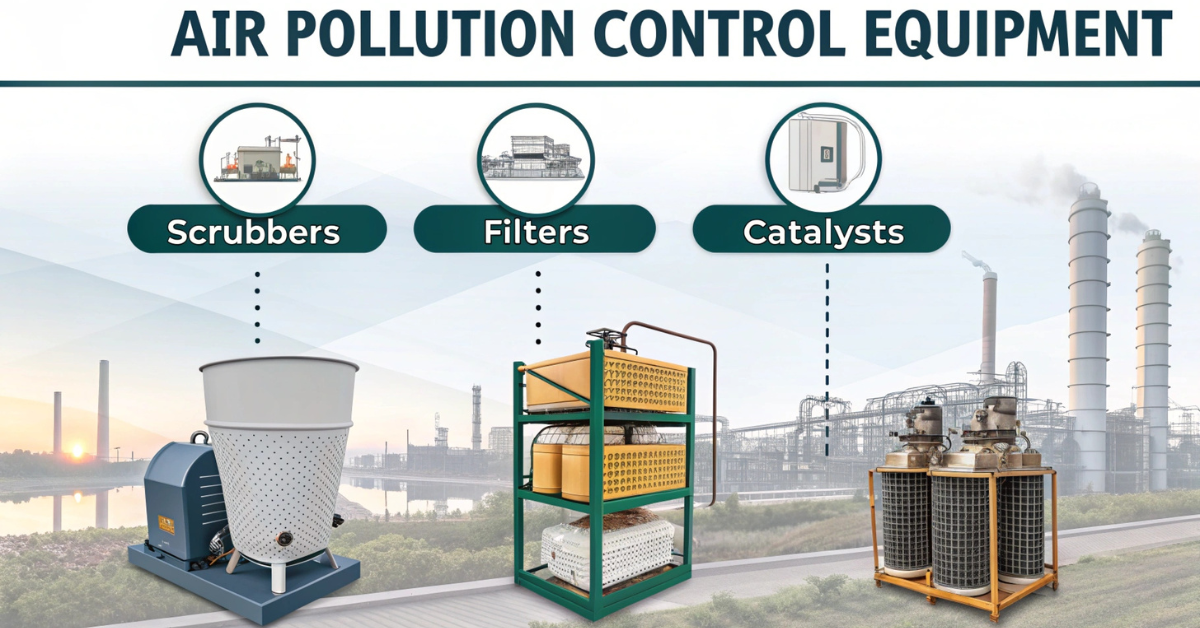
Wet scrubbers are versatile Air Pollution Control Equipment that use liquid, usually water or a chemical solution, to capture pollutants. As exhaust gas passes through the scrubber, contaminants are absorbed or neutralized by the liquid. Wet scrubbers are especially effective for removing acidic gases, fumes, and soluble particles. They are commonly used in chemical plants, refineries, and fertilizer industries where gas-phase pollutants are a concern.
Working Principles of Air Pollution Control Equipment
The working principles of Air Pollution Control Equipment vary based on design, but the core objective remains the same: separating pollutants from exhaust gases. Some systems rely on physical filtration, while others use electrical forces, chemical reactions, or fluid dynamics. Understanding these principles helps industries select the most suitable equipment for their emission profile and operational requirements.
How Filtration-Based Systems Work
Filtration-based Air Pollution Control Equipment, such as bag filters, relies on porous media to trap particulate matter. As polluted air flows through the filter, particles are captured on the surface or within the fabric. Over time, a dust cake forms, which actually improves filtration efficiency. Periodic cleaning mechanisms ensure consistent airflow and long service life without compromising performance.
Electrical and Mechanical Separation Methods
Electrostatic precipitators and cyclone separators use electrical and mechanical forces to remove pollutants. In electrostatic systems, electrical charging and attraction are the key mechanisms, while cyclone separators depend on inertia and centrifugal force. These types of Air Pollution Control Equipment are valued for their durability and ability to handle high-temperature and high-volume gas streams with relatively low pressure drop.
Chemical Absorption and Neutralization
Wet scrubbers and similar systems use chemical reactions to neutralize harmful gases. Pollutants such as sulfur dioxide or ammonia dissolve in the scrubbing liquid and are either removed or converted into less harmful compounds. This category of Air Pollution Control Equipment is especially important in industries dealing with corrosive or toxic gaseous emissions that cannot be captured through dry filtration alone.
Industrial Applications of Air Pollution Control Equipment
Air Pollution Control Equipment is used across a wide range of industries, each with unique emission challenges. Power plants rely on these systems to control fly ash and flue gases, while cement plants use them to manage kiln dust. In metal processing and foundries, pollution control equipment captures fumes and metallic particles generated during high-temperature operations.
Role in Manufacturing and Process Industries
Manufacturing units such as chemical plants, pharmaceuticals, and food processing facilities use Air Pollution Control Equipment to ensure product quality and worker safety. Clean air within and around the facility reduces contamination risks and supports compliance with health and safety regulations. In many cases, effective pollution control also improves process efficiency by recovering valuable materials from exhaust streams.
Environmental and Economic Benefits
Beyond regulatory compliance, Air Pollution Control Equipment offers long-term environmental and economic advantages. Cleaner emissions help protect ecosystems and reduce healthcare costs associated with pollution-related illnesses. From a business perspective, investing in efficient equipment can reduce fines, improve brand reputation, and enhance operational reliability. Many industries also benefit from energy recovery and material reuse made possible by modern pollution control systems.
Choosing the Right Air Pollution Control Equipment
Selecting the right Air Pollution Control Equipment requires careful evaluation of emission characteristics, operating conditions, and regulatory requirements. Factors such as particle size, gas composition, temperature, and flow rate play a crucial role in determining the most effective solution. Consulting with experienced engineers and equipment manufacturers ensures optimal performance and long-term cost efficiency.
Air Pollution Control Equipment is no longer optional for modern industries—it is a fundamental component of responsible and sustainable operations. By understanding the different types, working principles, and applications, businesses can make informed decisions that protect the environment while maintaining productivity. As emission standards continue to evolve, investing in reliable and efficient pollution control systems will remain essential for industrial success and environmental stewardship.
If you are planning to install or upgrade Air Pollution Control Equipment for your industrial setup, Par Boiler can help you choose the right solution with confidence. Get expert guidance, proven designs, and dependable after-sales support—all under one roof.
Contact Par Boiler today to discuss your air pollution control requirements and take a step toward cleaner, compliant, and more efficient operations.